Garage Doors
Helpful reading
Understanding the why behind a repair makes the fix easier to trust. Our advice pages explain how each part works, what happens when it wears, and how the repair restores it.
The questions that come up
What gets lubricated, and what is left dry?
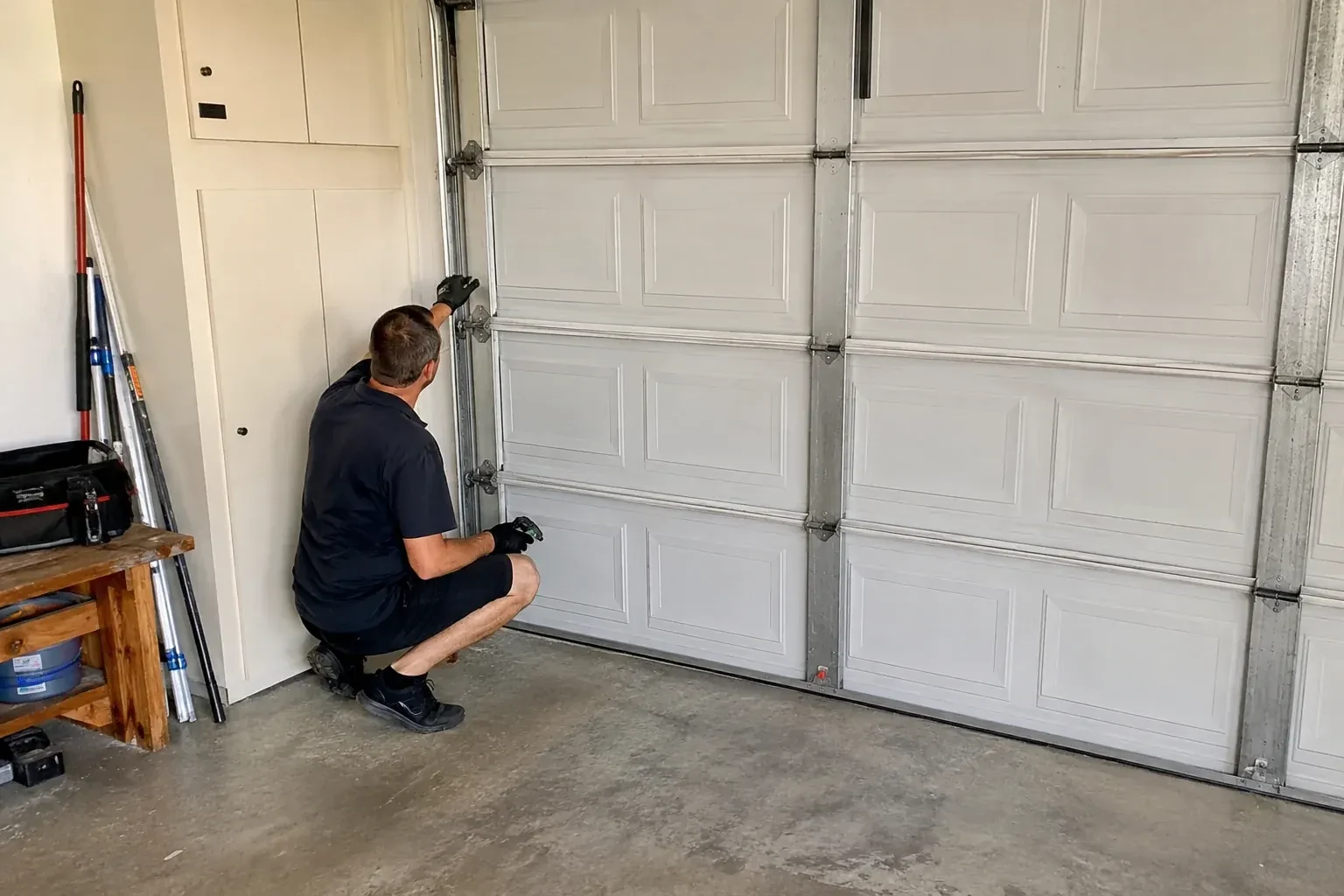
The moving metal-on-metal points get a light coat: the spring coils, the hinge knuckles, the roller bearings and the pins at the bottom brackets. A silicone or lithium product made for doors is used, then the door cycles a few times to carry it in. The tracks are the exception; they are cleaned and left bare, since a slick track lets the wheels skid and holds grit against them.
Does road salt harm the door?
Salt carried in on tires and shovelled snow settles on the lowest hardware: the bottom brackets, the lower track, the bottom roller stems and fixture bolts. Those are the parts that carry the door's weight, so corrosion there matters. Rinsing the lower hardware and the inside face of the bottom section after winter, keeping the floor by the tracks swept, and having the bottom brackets looked at each spring keeps salt from becoming a structural problem.
I only tapped the door with the bumper. Why is it off its track?
A sectional door is strong in the direction it travels and surprisingly easy to push sideways at a single roller. A light nudge on the bottom section can flex the track lip enough for the roller to slip out, after which the section twists and the rollers above follow. The good news is that this kind of event usually leaves the cables and springs alone, so the reset is often rollers, a re-formed track lip and a hinge check.
My door is insulated. Does the new section need the same insulation?
It should. Insulated sections come in different thicknesses and core types, and the replacement needs to match yours so the joints line up, the hinges sit at the right depth and the weight stays consistent with the springs. Mixing an insulated section into an uninsulated door, or the reverse, generally means a step at the joint and a change in balance. The technician reads the thickness and core type from the door before ordering.
Can mice get past a garage door bottom seal?
A worn, hardened or chewed seal is one of their favourite routes, and even a small gap at a corner is enough. A fresh, continuous seal sized to the floor removes that route. For a garage with repeated trouble, seals with a stainless mesh embedded in the vinyl are available and resist chewing. Keeping the jamb seals sound at floor level matters just as much, since a gap beside the door serves them equally well.
How should I look after the new seal?
Four times a year, check for daylight from inside with the lights off and press the fin to feel that it is still soft. Wipe the seal with a damp cloth to clear grit and salt, keep paint off the fin, apply a silicone wipe before winter, and keep slush and bins away from the bottom of the jambs. Press any lifted corner back and call if a length has come loose.
I have no key for the outside handle. Can it be made to work?
Yes. The cylinder is removed and either rekeyed to a fresh combination, so any key held by a previous owner is retired, or replaced with a new cylinder carrying the correct tailpiece. New keys are cut and tested in the handle before the technician leaves. If a locked door has to be opened first, the technician confirms your connection to the property as a matter of course.
How many ball bearings should a roller have?
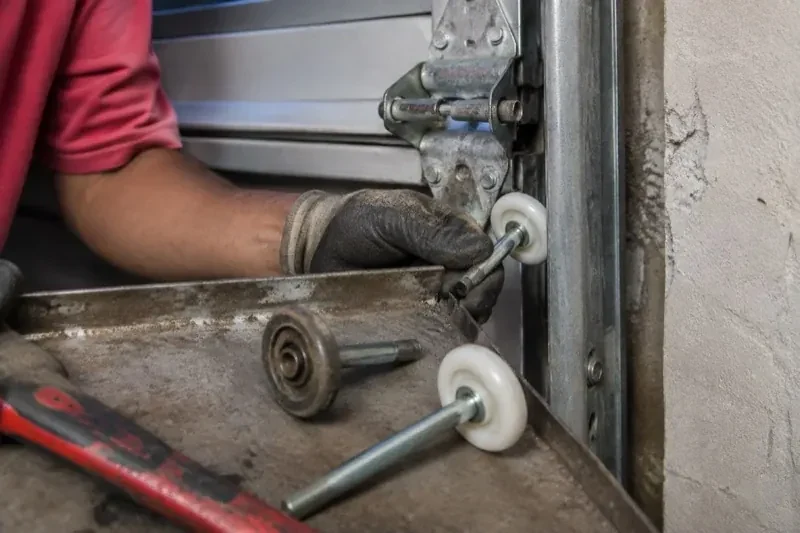
More bearings spread the door's weight over more contact points, but count alone does not decide how smoothly, quietly or long a roller runs; the complete design matters more. Budget rollers carry six or seven, better residential rollers ten to thirteen, and premium rollers use a sealed cartridge with a dust and moisture seal. For an ordinary residential door, a nylon roller with ten or more bearings is a sound choice; for a damp or salty garage, or a door used constantly, sealed bearings are worth asking about.
What do the numbers stamped on garage door hinges mean?
They mark the joint the hinge belongs to, counted from the bottom. A 1 goes at the joint above the bottom panel, a 2 at the next one up, then 3, with 4 and 5 on taller doors. Each higher number stands the roller a little further off the door face, so the door leans into the jambs when closed and follows the track as it climbs. Centre hinges use the geometry of a 1.
Can a low-headroom or high-lift layout be fitted to my existing door?
Often, yes, and it is a track job with a spring job attached. Low-headroom dual track lets a door open under a low ceiling or a beam, while high-lift track carries the door further up the wall to clear a car lift or storage. Each changes the horizontal run, the curve, the top fixtures and usually the cable drums and spring turns. The technician measures headroom, sideroom and backroom first and confirms the door suits the change.
Can I lift the door by hand while a cable is off?
Leave it. With one cable slack the door is being carried on one side only, so it is unbalanced and may bind or drop unevenly when moved. The technician arrives with clamps and a method for taking the door's weight before anything is moved, and that is the moment to lift it. Until then a stationary door is exactly what you want.
What is the difference between torsion and extension springs?
Torsion springs mount on a shaft above the door and twist to store energy, lifting the door through cables and drums. Extension springs run alongside the horizontal tracks and stretch as the door closes, pulling it up through pulleys. Torsion systems tend to lift more evenly, take up less space beside the tracks and are the standard on most modern doors. Both are professional service items because of the energy they hold.
Could I switch to torsion springs instead of replacing the extension ones?
Sometimes, and it is worth asking. A torsion system needs room above the door opening for its shaft and a header that can carry the spring bracket, which many older garages with a low ceiling simply lack; extension springs are there for that reason. Where the headroom exists, a conversion is a separate job with its own hardware and quote. The technician can tell you on the spot which route suits your garage.
The door was fine until a power cut. Why is it heavy now?
During a power cut the door is often released and moved by hand for the first time in years, and what people discover is a door that had already grown heavy while the opener quietly covered for it. The outage did not change the springs; it revealed them. A balance check confirms what the door weighs against what the springs give, and resets them to match.
What do the blinking lights on the opener mean?
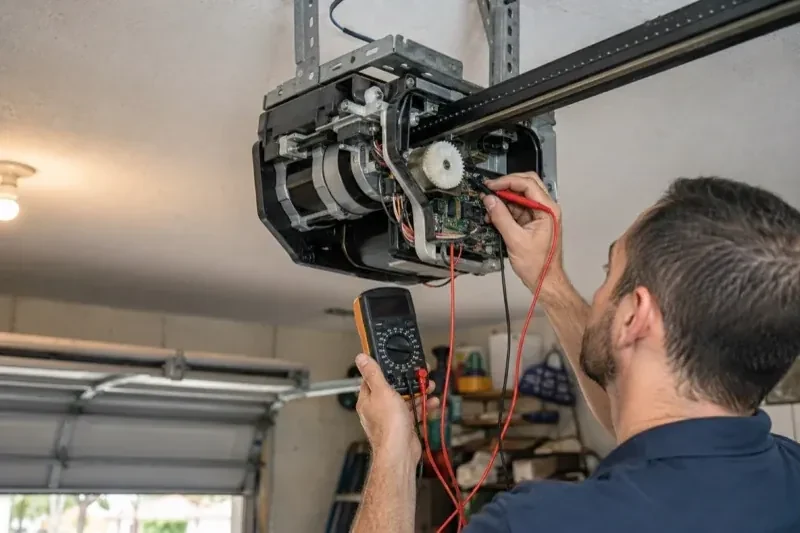
They are a diagnostic code. On openers made in roughly the past fifteen years, the head unit flashes its lights, or a pair of up and down arrows, in a counted pattern such as one flash then five. Each pattern corresponds to a fault family on the maker's chart for that model: sensor circuit obstructed or open, motor commanded but not moving, more force than allowed. The technician reads the pattern, then confirms it by hand, since one fault can imitate another.
Why does the door jerk or jump at the same spot every time?
A repeatable jolt at one point on the rail is usually a chain problem meeting a sprocket problem: a stiff link or a spread master link passing over worn sprocket teeth, so the chain rides up and drops a tooth. It can also be a burr or a splice plate on the rail where the trolley catches, or a roller on the door hanging up in the track at that height. The technician runs the door by hand first to tell the two apart.
The motor runs but the door stays still. What has happened?
Something between the motor and the door has let go. On a belt drive the usual suspects are a broken clip where the belt joins the trolley, a belt that has jumped off the sprocket or idler pulley, a trolley that failed to re-engage after the red cord was pulled, or a stripped drive gear inside the motor head, which leaves plastic shavings on the housing. Each is a specific repair.
The door is frozen to the floor. Why does the opener reverse?
Because the operator is protecting the door. Its force setting is tuned to the small effort a balanced door needs, so a seal glued to the concrete by ice registers as an obstruction and the door heads back up rather than ripping the rubber or bowing the top panel. Loosen the seal with a plastic scraper or a hair dryer along the sill, then try again; a shovelled threshold before a cold night keeps it from recurring.
How high off the floor should the sensors sit?
Low. The industry checklist expects the beam no more than roughly 15 cm (6 in) up from the floor, so that a small child, a pet or a bicycle wheel breaks it. Both sensors are set at the same measured height and level with each other, since a difference of a couple of centimetres is enough to lose the beam. Within that rule the technician can raise them a little to keep them out of the strip where slush collects.
The wall button works but none of the remotes do. Is that a programming job?
Sometimes, but the technician rules out two things first. Lock mode on the wall control tells the opener to ignore every remote, and gives itself away by a steadily blinking wall indicator and two flashes of the opener light whenever a remote is pressed; holding the lock button releases it. A memory cleared by a long press on the learn button is the other cause, and that one is a programming job.
The previous owner's controller is still on the ceiling. Can I use it?
Usually, once it is released from their account. If the seller can be reached, they remove the device from their app; if not, the technician performs a factory reset using the maker's documented steps, which clears the old registration. The hub and sensor are then paired fresh, joined to your network and claimed under your own login, and the battery and sensor placement are checked rather than assumed.
My door lets go of the opener partway through travel. Why?
A release lever that is only half-latched will hold until the door's weight shifts, then drop out. That points to a weak or missing lever spring, a bent lever, or worn latch teeth on the trolley. It can also follow a hard pull on the cord that left the lever cocked. The fix is a new spring or lever, or a new trolley, and a check that the door is balanced so the trolley is not carrying more than it should.
How can I tell if the balance has changed later?
During a planned manual check, a meaningful change may appear as a door that feels much heavier, will not remain controlled at an intermediate position or begins moving unevenly. New cable slack, rubbing or abrupt travel also deserves attention. Note the position and behaviour, then keep the door still for a technician's assessment.
Will an insulated door make the garage quieter?
Insulated, steel-backed sections are often more rigid and can sound less hollow than a thin single-skin door. Overall noise also comes from rollers, hinges, track alignment, counterbalance, the operator and vibration transferred into framing. Installation addresses those connected parts through alignment, fastening, balance and appropriate lubrication, giving the new assembly a sound mechanical foundation.
Do the tracks form part of the wind-rated system?
Yes. Tracks guide the rollers during daily travel and help retain the closed door when pressure acts across it. Gauge, shape, brackets, roller stems, fasteners, and attachment spacing may differ from a standard installation. That is why a wind-rated replacement is planned as a coordinated assembly instead of pairing reinforced sections with whichever tracks happen to be present.
Can a carriage-house door work with low headroom?
It often can, provided the available space is measured and a suitable track and spring arrangement exists for the selected door. Low-headroom layouts change how the top section turns and where hardware sits above the opening. Ceiling obstructions and opener geometry must be considered at the same time, so this condition belongs in the survey before the door configuration is ordered.
How are glass sections protected during installation?
Sections stay in their protective packaging until they can be checked and staged safely. They are stored upright or on padded, non-marring supports as directed, with glass faces separated from tools and rough surfaces. Handling uses the frame and designated lift points instead of the panes or glazing beads, and protective film remains until the instructed stage of assembly.
What electrical preparation does a garage door operator need?
Preparation commonly includes a receptacle near the planned operator, a suitable mounting location and routes for the wall control and photoelectric sensor wiring. Exact electrical requirements follow the chosen equipment and project electrical design. Coordinating locations before drywall helps keep wires clear of tracks, springs and moving sections. The electrical trade and door installer should also agree who completes connections and when power becomes available for commissioning.
Can the opening stay in use while work is underway?
The repair area needs controlled access while the door is supported, tensioned components are handled and operational tests are performed. Facilities can redirect pedestrians, forklifts and vehicles to another route and keep stored goods clear of the tracks and threshold. Once tools and supports are removed, the technician completes the agreed tests before returning the bay to normal traffic.
Can guide damage be straightened instead of replaced?
Some local bends can be corrected when the guide retains its strength, fastening points and required profile. Creased, torn, heavily corroded or repeatedly struck sections may call for compatible replacement. The choice also depends on guide gap, endlock or windlock arrangement, mounting construction and whether the door is part of a labelled fire-protection assembly.
Why is manual balance checked before powered operation?
The operator is intended to move a properly counterbalanced door, not compensate for an unsuitable spring or drum setup. Manual checks show how the door behaves without motor force and help technicians refine spring adjustment for the finished geometry. Once movement is controlled and consistent, powered commissioning can focus on limits, controls and protective devices rather than masking a mechanical issue.