Springs · Toronto
Extension Spring Replacement
You pulled the red cord to open the door during a power cut and it barely moved.
In plain words
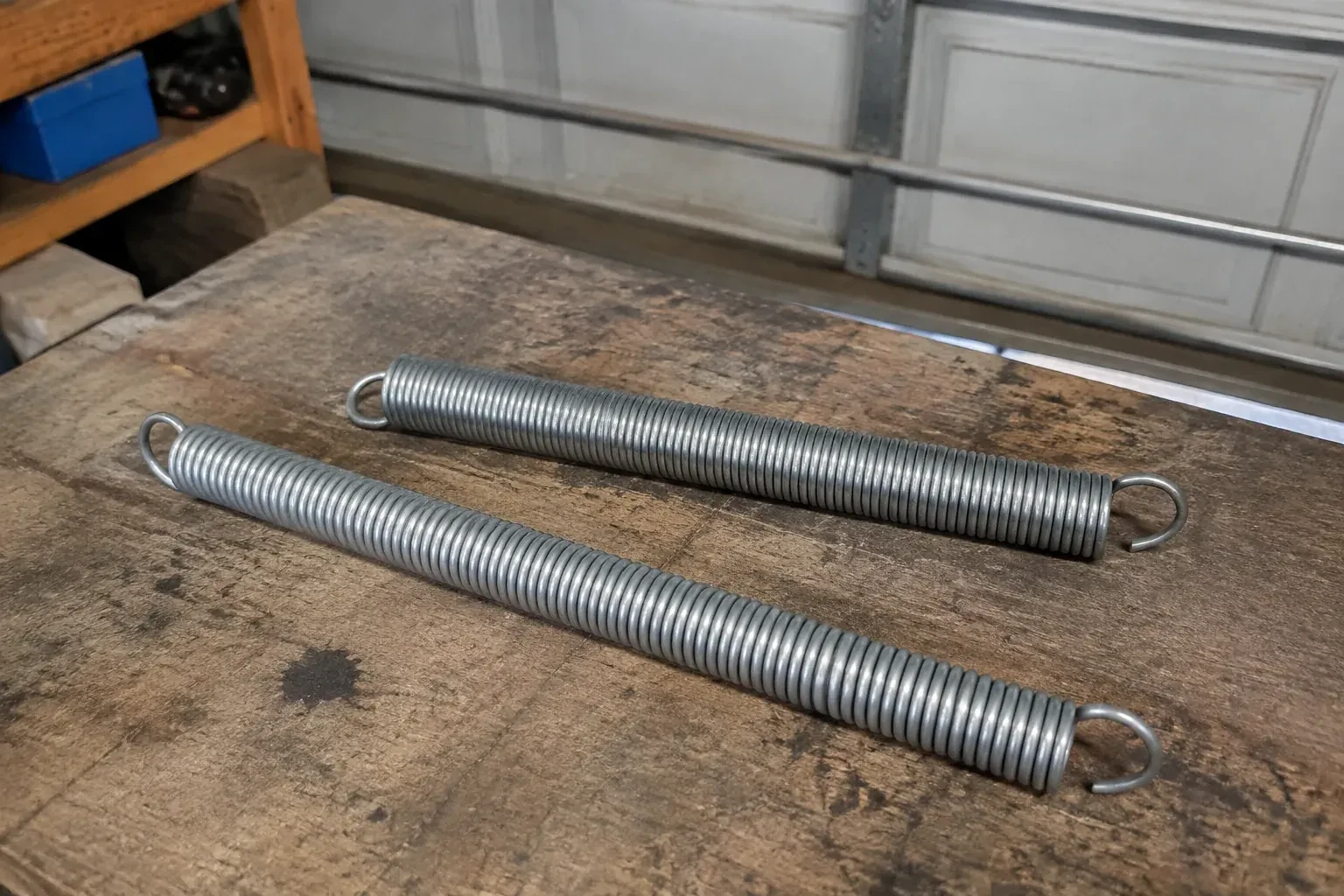
Choosing the right spring is a matter of weight, not colour. Extension springs are rated for the weight they are meant to lift, and the correct pair for your door is found by weighing the door itself with the opener released, then checking that figure against the wire size, coil diameter and length of the old springs. Paint colour on the end coil is only a hint; older springs fade, get overpainted or were never quite right to begin with. A pair matched to the measured weight gives a door that holds at half height and lifts with one hand, and an opener that works lightly.
How the visit goesThe door climbs with the left corner ahead of the right, then twists as it turns into the ceiling track. Looking up, the spring on the right side is stretched longer than its partner, with daylight showing between the coils.
Extension Spring Replacement
How the visit goes
Hangers, brackets and what they are screwed into
Extension springs pull against whatever holds their back end, usually an angle-iron hanger bolted to the rear track support or lag-screwed into a ceiling joist. The technician checks that this anchor is tight, that the lag screws bite into wood rather than drywall or a split joist, and that the hanger has not bent under years of load. The bracket that carries the fixed pulley at the front of the track is checked the same way, along with the bottom brackets on the door that the lift cables pull on. An anchor that has loosened lets the spring's geometry drift, which is one reason a door slowly becomes uneven.
Running the lift cables
Each lift cable starts at the bottom bracket, where its loop goes over the pin or is secured with a clevis pin. From there it runs up the vertical track, over the fixed pulley at the front of the horizontal track, back along the track to the pulley on the end of the spring, around it, and forward again to the S-hook or adjusting clip at the front hanger. The technician keeps the cable seated in each pulley groove and makes sure it passes on the correct side of the containment cable and the track. Cables are renewed if the old ones showed any fraying or rust, and always as a pair of the same length.
A monthly look along the springs
Extension springs are easy to inspect because they hang in plain view. Once a month, with the door fully closed so the springs are stretched, stand inside and look along each one from the back hanger to the pulley. The coils should be evenly spaced along the whole length; a section stretched wider than the rest is a spring losing its temper. Then raise the door and look again: with the door open the coils should close up tight, and both springs should hang at the same height. Rust bloom, a pulley that sits crooked, a cable off its groove or a containment cable hanging loose are all worth a call while they are still small.
Extension Spring Replacement
In the van
Garage-door spray lubricant
Bottom brackets and clevis pins
Rear spring hangers and angle iron
S-hooks and adjusting clips
Containment (safety) cables
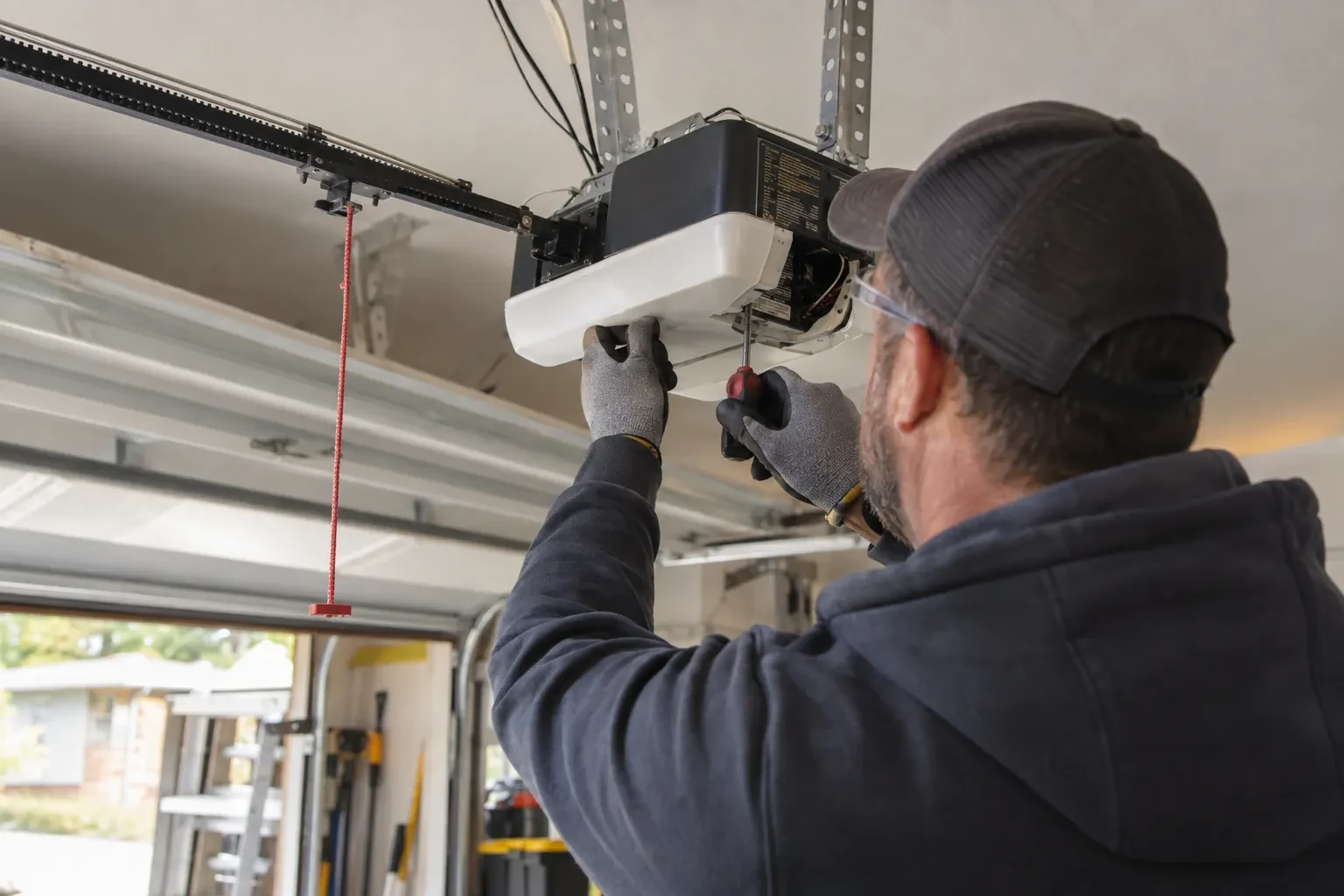
Extension Spring Replacement
What affects the quote
Getting the van to the garage
A detached garage down a shared laneway, a rural property or a building with the bay behind a gate takes more time to reach and set up in, and the quote allows for that.
Condition of the lift cables
Cables with fraying, rust at the loop or a kink are renewed as a pair while the springs are off. Sound cables are re-routed and set, and the quote says which applies.
Corroded fasteners
In an unheated garage the bolts through pulley forks and hanger brackets rust solid; freeing or cutting them and fitting new hardware takes time and shows in the parts list.
What to have ready
- Does the opener still move the door, and does it sound strained?
- Has insulation, glass or a wood facing been added to the door?
- Is there a thin cable running through the middle of each spring?
Extension Spring Replacement: questions
QuestionsCould I switch to torsion springs instead of replacing the extension ones?
Sometimes, and it is worth asking. A torsion system needs room above the door opening for its shaft and a header that can carry the spring bracket, which many older garages with a low ceiling simply lack; extension springs are there for that reason. Where the headroom exists, a conversion is a separate job with its own hardware and quote. The technician can tell you on the spot which route suits your garage.
What are the early signs that the springs are wearing out?
The door starts to feel heavier when lifted by hand and the opener sounds as though it is working harder. Released from the opener, the door sinks from halfway instead of holding. With the door open, gaps show between coils that used to sit tight together, or one spring hangs longer than the other. Rust bloom on the coils and a squeal from a pulley round out the list. Any of these is a good time to call.
What is a safety cable, and does my door need one?
A safety or containment cable is threaded down the inside of each extension spring and fixed at the hanger behind and the bracket in front. It carries no load in normal use. If a spring snaps, the cable keeps the broken halves in place beside the track. Every extension-spring door should have one each side, and the industry's inspection checklist asks for it. Doors installed decades ago often have none; they are added with the new springs.
Related services
- Garage Door Hinge ReplacementOn the old wood door, one hinge has pulled away from the panel, dragging a screw and a chunk of soft timber with it.
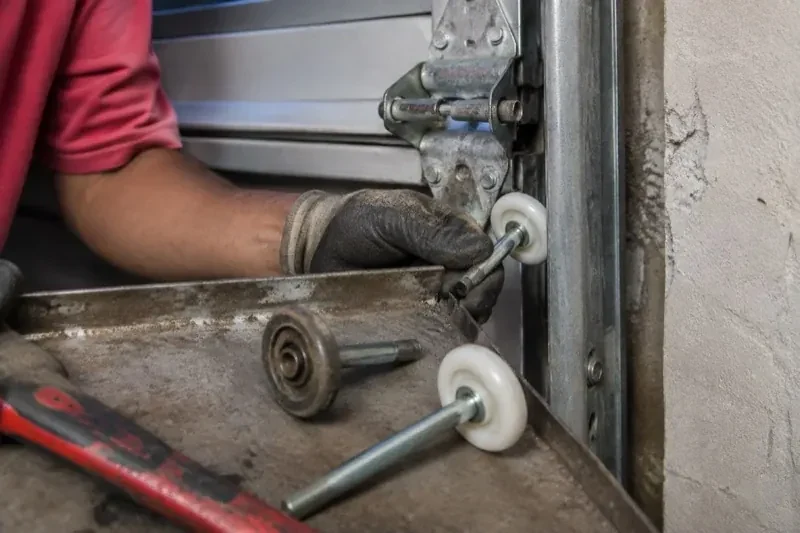
- Garage Door Track Repair or ReplacementHalfway up, the door lurches and one roller rides onto the lip of the channel.
- Garage Door Cable ReplacementThere was a sharp crack from the garage, and when you went to look the door had dropped on one side and jammed.