Springs · The Annex
Extension Spring Replacement in The Annex
You pulled the red cord to open the door during a power cut and it barely moved.
In plain words
Every extension spring should carry a containment cable, and replacement is the moment to make sure yours do. A containment cable runs through the centre of the spring and is anchored at both ends, to the rear hanger and to the bracket at the front of the track. It does no lifting; its purpose is to hold a spring that breaks so the pieces stay on the cable. Many older doors predate this practice, which a home inspection checklist checks for. When springs are replaced, new containment cables are fitted with them, which keeps a broken spring's pieces contained, not the door's weight, balance or safety.
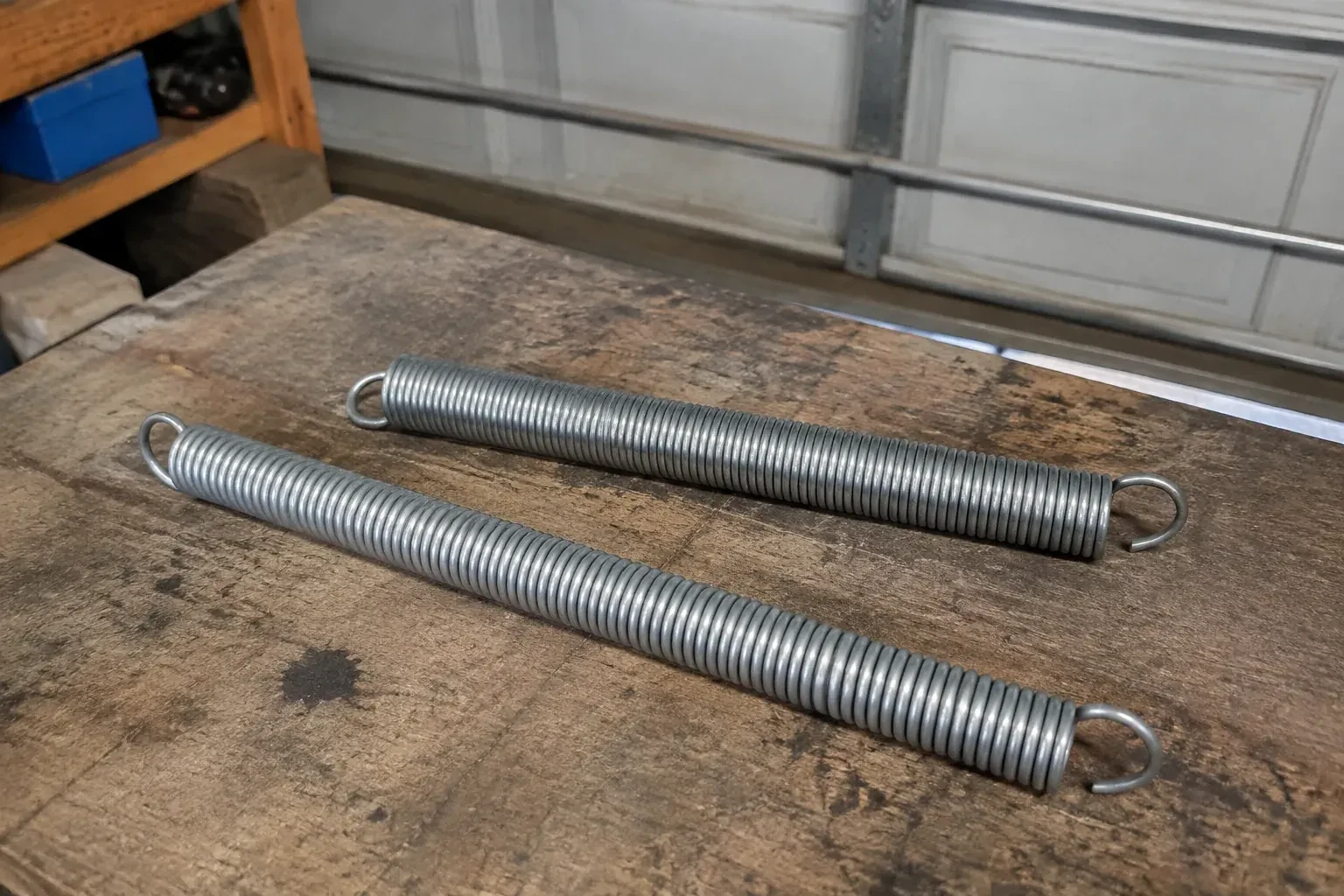
How the visit goesA bang like a dropped toolbox came from the garage last night. This morning one of the long springs beside the track hangs in two pieces, and the door will only rise a few inches before the opener gives up and stops.
Extension Spring Replacement
How the visit goes
Hangers, brackets and what they are screwed into
Extension springs pull against whatever holds their back end, usually an angle-iron hanger bolted to the rear track support or lag-screwed into a ceiling joist. The technician checks that this anchor is tight, that the lag screws bite into wood rather than drywall or a split joist, and that the hanger has not bent under years of load. The bracket that carries the fixed pulley at the front of the track is checked the same way, along with the bottom brackets on the door that the lift cables pull on. An anchor that has loosened lets the spring's geometry drift, which is one reason a door slowly becomes uneven.
Setting both sides to the same hole
The initial tension is set with the door open and clamped, so the technician is adjusting slack springs rather than loaded ones. Each cable's S-hook is placed in a hole on the hanger, or its clip set to a mark, and the two sides are put at the same position. The cables are drawn to the same snugness so that neither corner of the door is being pulled ahead of the other. A level across the top section confirms the door is square in its tracks. Only when both sides read the same do the clamps come off and the door come down for its first balance check.
Knowing when the next set is due
A standard extension spring is made for a set number of open-and-close cycles, commonly in the ten-thousand range, which on a door used four times a day works out to several years and on a door used twice a week to much longer. Springs age even when idle, as rust does its slow work in an unheated garage. The signs that the set is nearing the end are gradual: the door feels heavier by hand, the opener sounds as if it is working, the door drifts down from halfway, and gaps appear between coils when the door is open. Acting on those signs turns the next replacement into a planned appointment rather than a bang in the night.
Extension Spring Replacement
In the van
Garage-door spray lubricant
Bottom brackets and clevis pins
Rear spring hangers and angle iron
S-hooks and adjusting clips
Containment (safety) cables
Extension Spring Replacement
What affects the quote
How the door is sitting
A door resting closed with one spring gone is straightforward. A door stuck partway, twisted in its tracks or with a cable wrapped around a pulley has to be supported and straightened first.
Working room around the springs
Shelving, a stored canoe or a car parked under the tracks slows the work along the horizontal run. Clearing the sides of the garage beforehand keeps the time on the quote short.
One spring per side or two
Heavier doors sometimes carry a pair of springs on each side rather than one. Four springs, four containment cables and the extra setting time show as their own lines.
What to have ready
- Does one corner of the door hang lower than the other?
- Does the door drop the last bit, or drift up on its own?
- Do you know how old the springs are or when they were last changed?
Extension Spring Replacement: questions
QuestionsCould I switch to torsion springs instead of replacing the extension ones?
Sometimes, and it is worth asking. A torsion system needs room above the door opening for its shaft and a header that can carry the spring bracket, which many older garages with a low ceiling simply lack; extension springs are there for that reason. Where the headroom exists, a conversion is a separate job with its own hardware and quote. The technician can tell you on the spot which route suits your garage.
What are the early signs that the springs are wearing out?
The door starts to feel heavier when lifted by hand and the opener sounds as though it is working harder. Released from the opener, the door sinks from halfway instead of holding. With the door open, gaps show between coils that used to sit tight together, or one spring hangs longer than the other. Rust bloom on the coils and a squeal from a pulley round out the list. Any of these is a good time to call.
What is a safety cable, and does my door need one?
A safety or containment cable is threaded down the inside of each extension spring and fixed at the hanger behind and the bracket in front. It carries no load in normal use. If a spring snaps, the cable keeps the broken halves in place beside the track. Every extension-spring door should have one each side, and the industry's inspection checklist asks for it. Doors installed decades ago often have none; they are added with the new springs.
Related services
- Garage Door Hinge ReplacementOn the old wood door, one hinge has pulled away from the panel, dragging a screw and a chunk of soft timber with it.
- Garage Door Track Repair or ReplacementHalfway up, the door lurches and one roller rides onto the lip of the channel.
- Garage Door Cable ReplacementThere was a sharp crack from the garage, and when you went to look the door had dropped on one side and jammed.